



公開日 2026.11.19
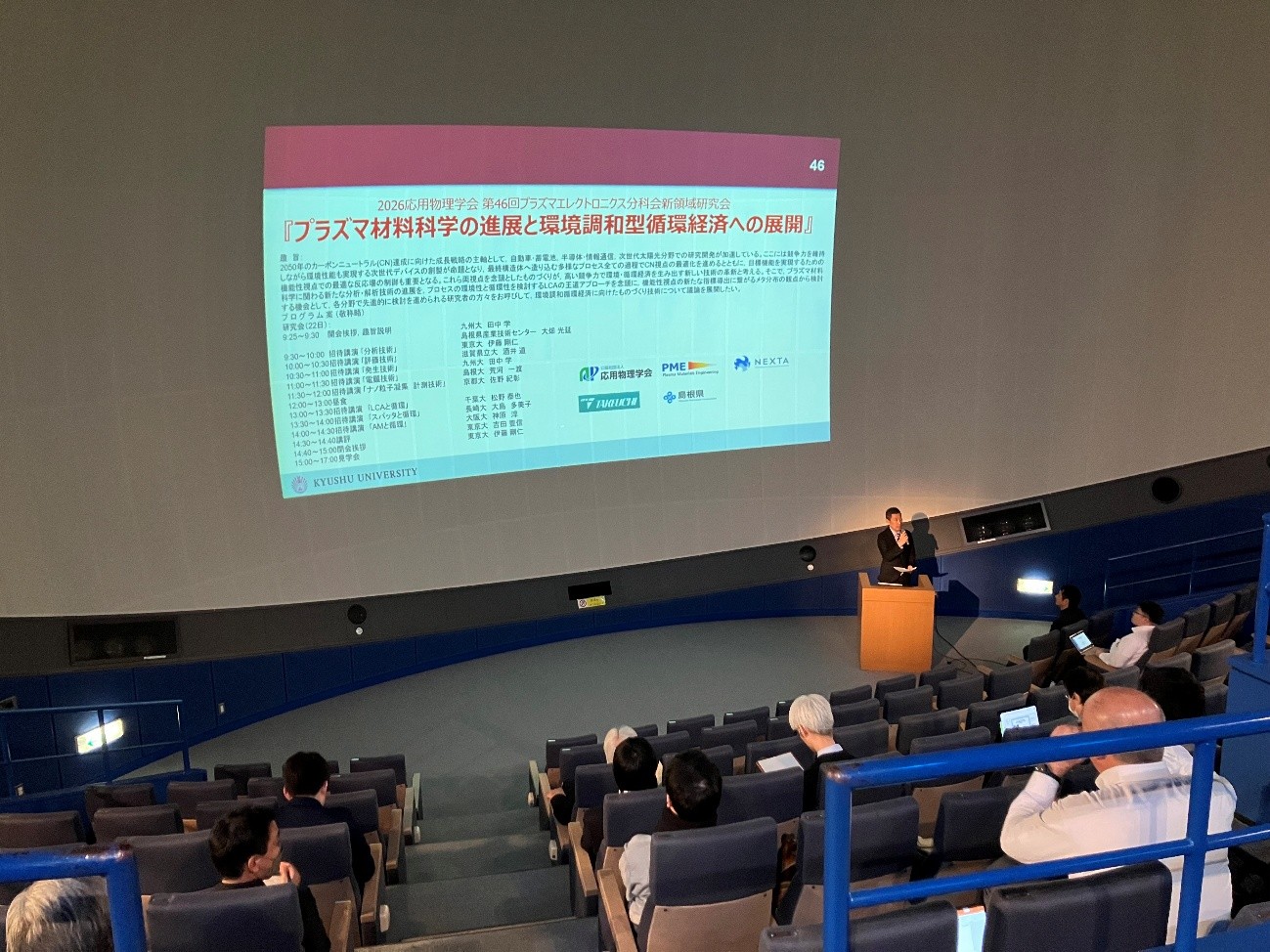
On March 22, 2026, the 25th NEXTA Forum was jointly held with the 46th Plasma Frontier Research Meeting at Matsue Terrsa in Matsue City, Shimane Prefecture. The event brought together 25 participants from universities, companies, and public research institutions, fostering active face-to-face discussions among researchers and practitioners.
The forum was organized by the Plasma Electronics Division of the Japan Society of Applied Physics and co-hosted by the Next Generation Tatara Co-Creation Centre (NEXTA), Shimane University, and other organizations. Under the theme of “Advances in Plasma Materials Science and Their Applications to an Environmentally Harmonized Circular Economy,” participants explored the role of plasma technologies in achieving sustainable manufacturing and resource circulation.
Symposium Program
With the realization of carbon neutrality by 2050 as a common goal, the forum addressed how advanced functionality in manufacturing can be balanced with reduced environmental impact and effective resource circulation. Discussions were conducted from interdisciplinary perspectives, focusing on both plasma technologies and Life Cycle Assessment (LCA).
The program began with an introduction to Shimane Prefecture’s initiatives by Dr. Mitsunobu Ohata, Director General of the Shimane Institute for Industrial Technology. This was followed by a keynote presentation from Prof. Tsuyohito Ito of the University of Tokyo, who provided a comprehensive overview of plasma reaction fields.
Subsequent presentations by Prof. Osamu Sakai of the University of Shiga Prefecture, Prof. Manabu Tanaka of Kyushu University, and Vice Director Kazuto Arakawa of NEXTA, Shimane University focused on understanding and controlling important concepts such as “distributions” and “fluctuations,” which play key roles in the creation of advanced material functions.
Prof. Noriaki Sano of Kyoto University introduced examples of in-situ measurement technologies used in manufacturing environments. Prof. Yasunari Matsuno of Chiba University discussed approaches to understanding material circulation through Life Cycle Assessment (LCA). In addition, Prof. Tamiko Ohshima of Nagasaki University presented research on the characterization of sputtered thin films, while Prof. Makoto Kambara of Osaka University introduced particle activation and regeneration (recycling) technologies for additive manufacturing. These presentations highlighted practical research achievements aimed at advancing sustainable resource and energy circulation.
The symposium concluded with remarks from Prof. Toyonobu Yoshida of the University of Tokyo, who emphasized the importance of establishing common perspectives for the practical implementation of plasma processes.
Technical Facility Tour
Following the symposium, participants visited the NEXTA Research Building at Shimane University, the Shimane Institute for Industrial Technology, and the Matsue Plant of Takeuchi Electric Co., Ltd.
The tour provided opportunities to observe state-of-the-art research facilities and actual manufacturing environments, allowing participants to gain firsthand insights into technological innovation initiatives being pursued in the region
Through forums such as this, NEXTA will continue to promote collaboration among academia, industry, and public research institutions, contributing to the development of next-generation materials and the realization of a sustainable, environmentally harmonized society.
Point of Contact
Next Generation Tatara Co-Creation Centre